
Flowing Through Time: Two Milestones for My River Futures Research
I’m grateful to share two pieces of good news for my work “Flowing Through Time: An Epistemological and Ontological Examination of River Futures Within Urban Landscapes” (University of the Sunshine Coast).
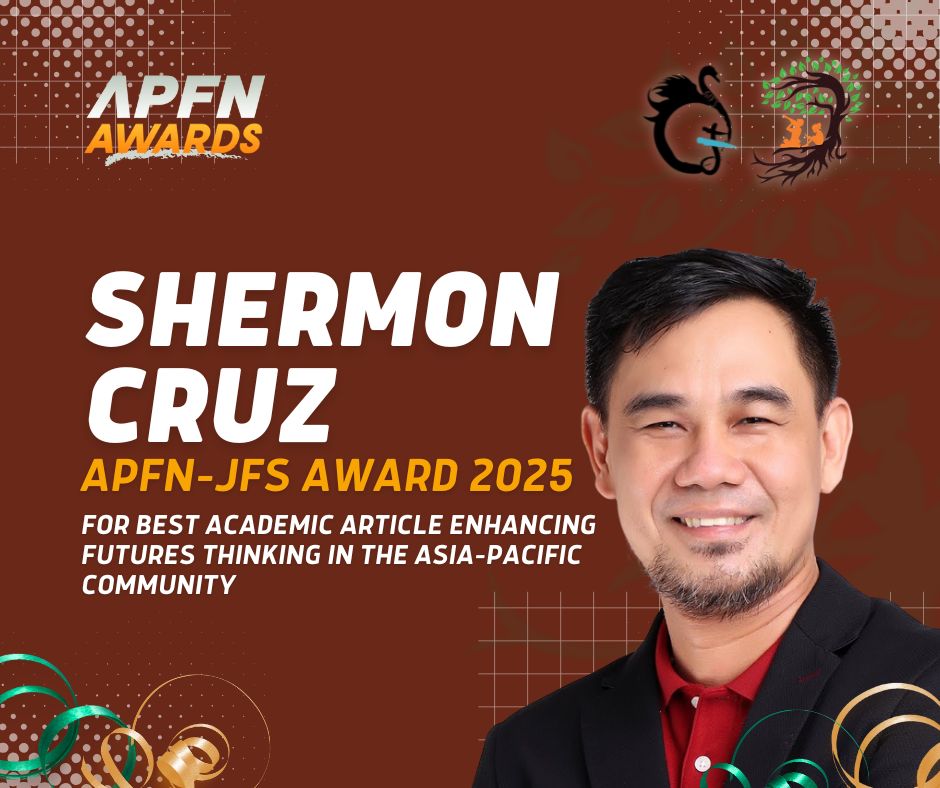
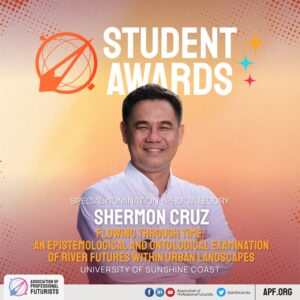
First, the work received an Association of Professional Futurists 2025 Student Awards recognition as a Special Nomination (PhD Category). Second, it was awarded the Asia Pacific Futures Network- Journal of Futures Studies Award 2025 for Best Academic Article Enhancing Futures Thinking in the Asia-Pacific Community.
These are the kinds of moments that make you pause not because the article finished (research is never finished; it just evolves) but because they affirm that the questions are worth asking, and that others also care about the same stubborn, living systems we’re trying to understand.
What the paper is trying to do
This research sits at the intersection of futures thinking, urban life, and rivers—not as scenery, but as active forces that shape cities and are shaped by them.
The title is a mouthful, but the core idea is simple:
Epistemology asks: How do we know what we know? (What counts as evidence? Whose knowledge is treated as legitimate? What gets ignored?)
Ontology asks: What is this thing we’re dealing with? (Is a river just a “resource” or “infrastructure”? Or is it a living system, a commons, a relationship, a cultural being, a teacher?)
When cities plan for the future, these assumptions quietly steer everything: policy, engineering choices, budgets, risk management, and what “success” even means. If our assumptions are too narrow, our futures become narrow too.
So “Flowing Through Time” is an attempt to widen the field—so river futures can be imagined and governed with more care, legitimacy, and long-term intelligence.
 Why this matters now
Across the Asia-Pacific, river-city systems are under pressure from overlapping forces: climate volatility, contested land use, infrastructure expansion, pollution, governance fragmentation, and community mistrust shaped by long histories.
In that kind of complexity, technical solutions alone don’t hold the line. What’s needed is a stronger foundation for decision-making—one that can carry uncertainty, conflict, and multiple truths without collapsing into either paralysis or overconfidence.
That’s where futures thinking becomes practical: not as prediction, but as disciplined imagination plus responsibility.
What I’m taking from these recognitions
I’m taking these awards as encouragement to keep doing three things:
Keep the work grounded. Futures thinking is strongest when it stays close to lived experience, place, and the realities of governance.
Keep the work plural. Rivers don’t belong to a single discipline, and neither should river futures.
Keep the work useful. If foresight doesn’t strengthen the ability to act (especially under stress, uncertainty, and leadership transition), it’s just clever conversation.
Thank you!
I’m thankful to the University of the Sunshine Coast for the scholarship that enabled me to study and pursue this research including Northwestern University and the Center for Engaged Foresight, the communities, mentors, colleagues, friends and collaborators who have shaped this work—through conversations, critique, field realities, and the steady reminder that futures thinking is ultimately about people, place, and responsibility.
And I’m grateful to the organizations, APF and the APFN, behind these recognitions especially those building the Asia-Pacific futures community and championing scholarship that strengthens practice.
Lifelong Learning
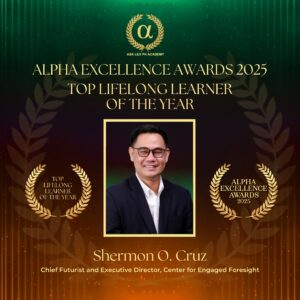
Alongside these recognitions, I was also honored to receive the Alpha Excellence Awards 2025 – Top Lifelong Learner of the Year, a recognition that reflects a long, ongoing commitment to learning as practice—across research, teaching, community work, and applied futures thinking.
What’s next
This milestone isn’t a finish line; it’s a marker on the riverbank of my PhD Candidacy at the University of the Sunshine Coast and as UNESCO Chair on Anticipatory Governance and Regenerative Cities at Northwestern University in the Philippines.
I’ll be continuing to develop this body of work through writing, teaching, and applied projects that explore how futures methods can support more regenerative, culturally grounded, and participatory ways of thinking about rivers in urban landscapes—especially in contexts where history, inequality, and governance complexity are part of the terrain.
If you’re working on river governance, urban resilience, futures methods, or community-led stewardship, I’d love for this piece to be useful to you—whether as a reference, a provocation, or a bridge to collaboration.
For copies of the articles, links here:
The Tale of Three Futures: Conquest, Reverence or Reconciliation?